DoorDash has agreed to buy Instacart for $17 billion, confirming talks first reported days earlier that had put the price in the same range. The combined company will face competition from Amazon, Uber, and Walmart in food and grocery delivery. The price is far below the $40 billion to $50 billion range discussed when the two companies talked in 2021.
Why it matters
Delivery is now a scale game, not a growth game. DoorDash is buying its biggest grocery rival at less than half the price discussed five years ago, which tells you the market now rewards profits and bargaining power over restaurant and grocer partners, not new users at any cost. For founders in delivery and local commerce, the message is plain: if you cannot reach scale on your own, the buyer sets the price, and the giants around you will keep getting bigger.
Microsoft is seeking to raise $25 billion in a bond sale, making it the second major cloud provider to raise debt to fund its data center buildout this year after Google. The sale comes as Microsoft's heavy spending on data centers has already dragged down its free cash flow, even as revenue growth picked up slightly. It follows voluntary buyouts offered to about 60,000 employees as the company works to pay for AI capacity.
Why it matters
Even the richest software company is now borrowing to build AI capacity, and it is cutting payroll at the same time. That combination, debt plus headcount cuts, is how the AI buildout gets paid for when growth alone is not enough. For everyone else, the warning is that cheap money for data centers is not guaranteed: lenders will ask harder questions, and companies that cannot show returns on their AI spending will feel the squeeze first.
As AI agents crowd onto the web, advertisers and publishers are beginning to deliver ads that only AI can see, rather than ads aimed at human eyes. Time magazine was the first publisher to experiment with this kind of invisible ad. The move has worried some agent developers, who fear marketers could try to steer agents to act without their users knowing.
Why it matters
Advertising is following the reader, and the reader is now a machine. If an agent picks your hotel, your groceries, or your software, then whoever can influence that agent influences the sale, even if you never see the pitch. That creates a trust problem fast: users will only let agents shop for them if they believe the agent works for them, not for the highest bidder. Expect rules, labels, and fights over what an agent is allowed to be shown.
OpenAI and ServiceNow expanded their partnership on October 28 to bring ServiceNow workflows into ChatGPT and Codex. A new ServiceNow integration will let teams investigate IT problems, judge the risk of a change, and update a ServiceNow record without leaving ChatGPT, while ServiceNow's Action Fabric applies each company's existing rules and permissions. ServiceNow will also give all of its employees access to ChatGPT Work and Codex, and plans a Codex integration for building applications, a joint security product, and a voice feature for describing an AI use case out loud. The ServiceNow plugin is in the OpenAI marketplace now, with stronger features due by the end of 2026, security tools in early access in January 2027, and the Codex application builder due in 2027.
Why it matters
ChatGPT is moving from answering questions to doing the job inside the software companies already run on. ServiceNow owns the IT ticket, the approval, and the record, so putting ChatGPT inside it gives OpenAI distribution that no new app launch can match. For startups selling business tools, the bar just rose: you now compete with a chatbot that can reach into the customer's own systems. The whole deal rests on permissions, so the winners will be the teams that prove an agent only touches what each employee is allowed to touch.
Shopify has adopted agentic payment technology from Visa and Mastercard, as the card networks push more merchants to use their own systems for AI-driven purchases. The move puts the card networks' payment rails inside the storefront where millions of small businesses sell. It follows earlier agent-payment efforts in which agents pay with single-use virtual cards, a setup that has raised questions about tracking purchases end to end and resolving disputes.
Why it matters
The fight over who gets paid when an agent buys something is moving from theory to the checkout page. Visa and Mastercard want the agent's purchase to run on their rails, with their rules, rather than on a new wallet or virtual card that cuts them out. For merchants, the choice of payment system is becoming a choice about who sees the transaction, who handles the dispute, and who takes the fee. For agent builders, the lesson is that distribution wins: the payment method already inside Shopify reaches more sellers than any new standard can.
Marvell is in talks to buy Lumentum, and a deal would rank as one of the largest semiconductor deals. The talks come as chipmakers race to supply the parts behind AI data centers, where moving data quickly between processors matters as much as the processors themselves. No terms have been announced, and talks could still fall apart.
Why it matters
The AI chip race is now about the connections between chips, not just the chips. Data centers need fast, reliable optical links to move huge amounts of information, and buying that capability is faster than building it. If this deal closes, expect more consolidation among the suppliers that feed the AI buildout, and expect the winners to be the companies that own a scarce piece of the data path, not just a faster processor.
Oracle's shares surged more than 10% after the company capped its capital spending and projected positive cash flow. Oracle described its 2028 and 2029 fiscal years as a period of peak capital spending, before cash flow turns positive. The move stands out in a week when other cloud giants are borrowing heavily to keep building.
Why it matters
Investors just rewarded the first big cloud company to draw a line under its AI spending. After months of open-ended buildout promises, a cap plus a date for positive cash flow gave the market something it could check. That puts pressure on every other builder: the question is no longer how much you can spend, but when the spending turns into cash. Companies that cannot answer that question will find their stock, and their borrowing costs, moving against them.
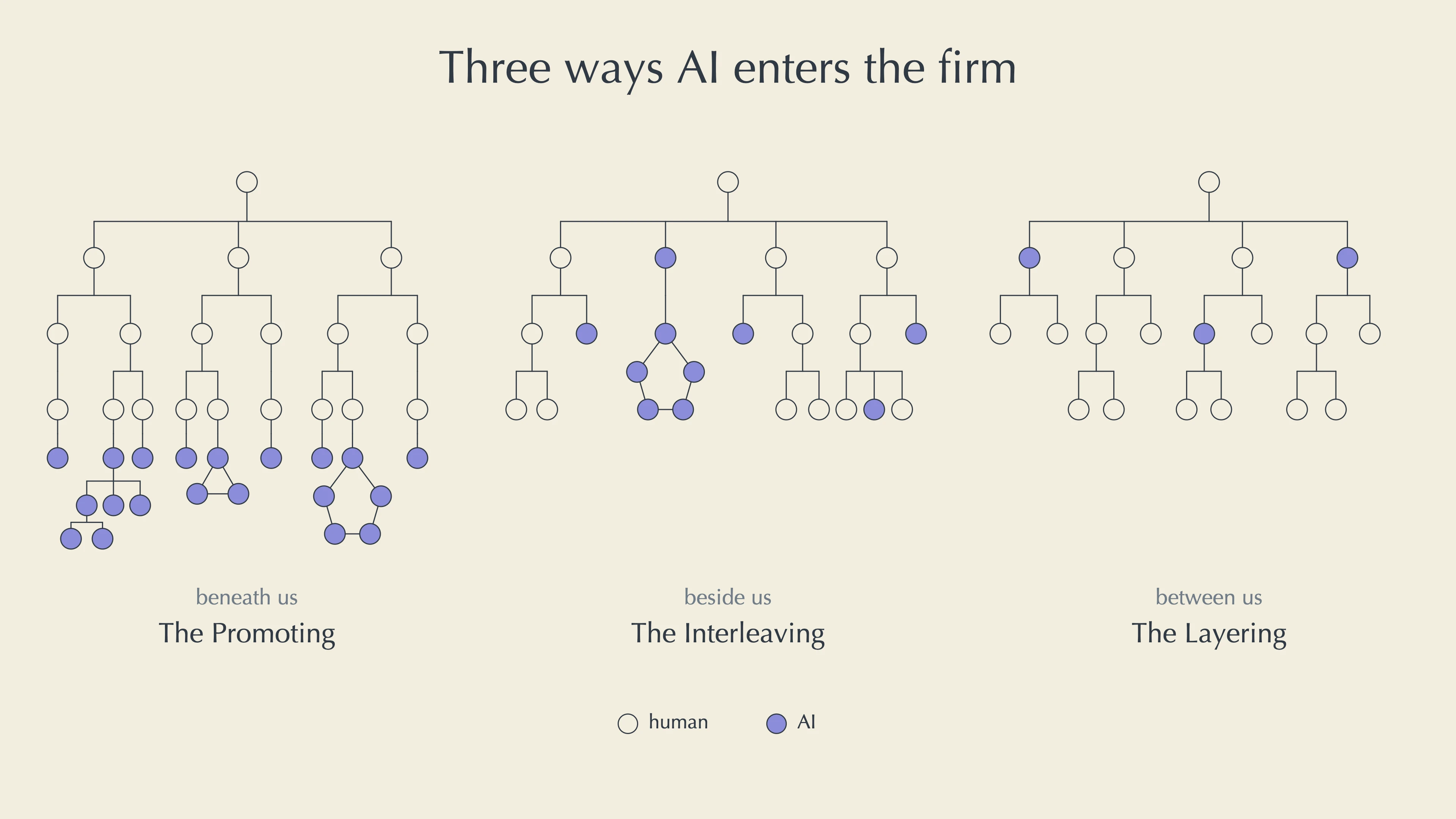
OpenAI published an essay on October 28 laying out three ways AI enters a company: beneath workers, as a team of agents each person manages; beside workers, as a colleague team that reports to a human manager; and between workers, as a layer that coordinates work and advises executives. The authors argue that management work, which lives mostly on computers and in decisions, may automate before some ground-level work, and that cheap building should push firms to try more and plan less. On balance, they expect workers to gain freedom, because an AI monitor that truly understands the work can replace crude tracking like clicks and status dots, and because executives will be alerted to big problems without needing to control every step.
Why it matters
The org chart is becoming a product decision, not just a management habit. If every employee manages agents, if agents sit beside teams, and if an AI adviser briefs the boss, then layers of middle management exist mainly to move information, and that job is exactly what AI does well. Founders should design for fewer information routers and more people who can judge good work, because the companies that keep every approval layer will simply move slower than the ones that let workers act with a clear record behind them.
On the October 28 episode of The a16z Show, Mark Cuban argued that AI could produce a trillionaire working alone, backed by a team of AI agents doing the work of a whole company. He also argued that AI will not fix health care on its own, because the real problem is hidden prices and broken incentives. His starting advice for employers is to run every benefits contract through AI and ask where they are being overcharged, and he said trust is the core product of his Cost Plus Drugs business. The episode also looks at personalized medicine, how the role of doctors may change, and why founders should use AI to learn rather than as an excuse to stop thinking.
Why it matters
Two ideas in one episode point in the same direction: the advantage is moving from headcount to trust and distribution. A single founder with agents can now do work that once needed a team, but only in markets where customers believe the price is honest. In health care, that means transparency is the product, not the AI itself. For founders, the practical test is simple: if your AI does the work but customers still do not trust the deal, fix the deal first.