Private tech funding is still running hot despite public-market fears of an AI bubble. Databricks raised $3.4 billion in a Series L round valuing it at $134 billion, one of the largest private raises ever, while Ramp raised $450 million at a $40 billion valuation, up from $22.5 billion in June. Other big raises included Celestial AI ($1.4 billion at $18 billion), OpenAI's $500 million India expansion, Vercel ($300 million at $9.3 billion), and xAI's $15 billion raise. New funds launched include Khosla Ventures' $1.4 billion fund and former Intel CEO Pat Gelsinger's $1 billion Playbook fund. The newsletter's warning: in the previous funding cycle only 13.5% of unicorns exited at or above their prior valuation.
Why it matters
Private investors are still writing the biggest checks in tech even as public markets wobble about an AI bubble. A $134 billion valuation for Databricks and a near-doubling for Ramp in four months set the price every late-stage AI company will be measured against. The warning inside the party: last cycle, fewer than one in seven unicorns ever exited at or above their last private price.
OpenAI is accelerating plans to bring ads to ChatGPT's free and lower-tier products by early next year. The company has hired at least two former Meta ads executives, including David Schlossberg, formerly Meta's VP of product for advertising, who joined last month, and is building an ad sales team. OpenAI is reportedly pricing ads 50% below the fees on Google's ad exchange, mirroring Meta's early approach of keeping prices low to build advertiser habit. Microsoft is involved in the monetization discussions.
Why it matters
The company that once said it would never do ads is now hiring Meta's ad people and undercutting Google by half to win advertisers fast. Cheap early ad prices are how Meta built its money machine, and OpenAI is copying the playbook. Anyone selling AI subscriptions should watch: when the biggest consumer AI product goes free-plus-ads, the price of every paid tier gets questioned.
Meta released the weights for Muse Spark Open, which it calls the most capable US open-weight model to date. It is a natively multimodal mixture-of-experts model with 816 billion total parameters and 42 billion active per token, a 1-million-token context window, built for coding and agentic work. Weights are downloadable on Hugging Face, Amazon SageMaker AI, Google Cloud Model Garden, and Microsoft Foundry Models, with hosted inference via Baseten, Fireworks AI, Groq, Modal, Nebius, OpenRouter, and Together AI. Meta says it is the first model in its class to run on a desktop: two Apple M5 Ultra Mac Studios using the MLX framework. On Meta's benchmark table it leads comparable open models on MCP-Atlas (89.2), JobBench (61.8), HLE-Diamond without tools (26.1), ZeroBench with tools (50.0), and SimpleVQA (73.6), but trails China's Kimi K3 on Terminal-Bench 2.1 (76.4 vs 85.0) and on the Artificial Analysis Intelligence Index (39 vs 44). The license requires a 'Built with Muse Spark Open' label and a separate Meta agreement for providers over $20 million in 12-month revenue offering it as a hosted service.
Why it matters
Meta just gave away an 816-billion-parameter coding model that anyone can download and run, even on two desktop Macs. For startups this is a real alternative to paying API bills: self-host a frontier-class coding backbone and keep your data in-house. For closed-model providers it is price pressure from below, for free. The catch is the license: Meta still takes a cut from the biggest commercial hosts.
China's Ministry of Commerce issued a draft plan to add 40 technologies across AI, biomedicine, and photovoltaics to its restricted-technologies list, covering 23 AI-related technologies including large language models, AI agents, chip design, and computing clusters. Companies would need government approval to transfer the largest models, their code, or designs overseas, while technologies already available via published papers or open source would be exempt. Public comment is open until November 15, and an immediate registration requirement covering ownership transfers, licensing, and pending transactions took effect Friday. The move comes as Chinese models like Moonshot AI's Kimi K3 and Z.ai's GLM-5.3 gain global popularity.
Why it matters
China is writing the rules that decide which AI technology can leave the country, from large language models to the chip designs and computing clusters behind them. The immediate bite is paperwork: companies must now register ownership transfers and licenses. The bigger signal is timing, coming just as Chinese models like Kimi K3 and GLM-5.3 win global users. Expect every lab with Chinese operations to redraw its compliance map.
In the weeks before SpaceX's AI unit (now SpaceXSI) launched Grok Bot in August, Cursor engineers discovered that internal testing data from the tool, code-named 'Sand', potentially including confidential customer, supplier, and partner information, may have been sent to SpaceXSI for AI training. One Cursor lawyer warned it could cause a 'huge trust problem' and that 'legally, we arguably don't have the rights to train on this data.' Cursor investigated what data reached SpaceXSI (the outcome is unknown) and moved to exclude employee data from future training and require work emails for access. This happened while SpaceX was acquiring Cursor for $60 billion, a deal completed in mid-August. Separately, Cursor sales and marketing staff inadvertently exposed customer data, including Verizon's org chart, top users, spend, and emails plus Bosch and Coupa data, via Vercel-hosted websites with passwords embedded in public code.
Why it matters
Cursor may have sent confidential customer and partner data to SpaceX's AI unit for training, and its own lawyer said the company arguably had no right to do it. This happened inside a $60 billion acquisition, which makes it a case study in how fast trust can break when data crosses company lines. The lesson for every startup: write down what customer data can be used for training before a deal forces the question, not after.
Anthropic has begun embedding outside AI evaluators inside the company to assess and publish reports on its safety practices and risks. Six staff from the nonprofits METR and SecureBio, plus Accenture's AI unit, are first in: METR gets company hardware, office space, and internal tool access roughly on par with Anthropic's own risk assessment teams, minus narrowly defined exclusions (customer data, attorney-client material, model architectures). METR publishes its risk assessments and Anthropic cannot veto publication, only require redactions in predefined categories. SecureBio is reviewing the chemical and biological weapons chapter of Anthropic's August Risk Report, and Anthropic hopes to bring in Hugging Face. Evaluators may not hold Anthropic equity or be financially or operationally dependent on the company. The move follows CEO Dario Amodei's pledge, made with OpenAI, after agents from both companies breached guardrails.
Why it matters
Anthropic is letting outside safety experts work inside the company with employee-level access and publish what they find without a veto. That is the closest thing AI has to an independent audit, and once METR's first reports land, every other lab will be asked why it does not do the same. For investors and enterprise buyers, those reports become a public scorecard for which labs take safety seriously.
Apple is in talks with the DOJ to settle a 2024 antitrust lawsuit by loosening App Store rules so developers can use non-Apple payment systems. Some developers fear the deal could preserve Apple's 27% fee on purchases made outside the App Store and leave it to Apple to define 'fair' terms. Apple would also seek to restrict future DOJ actions to the specific conduct in the suit and likely keep the deal in place through the 2028 election. Developers are pushing for the DOJ to reject the terms. The proposed settlement echoes Epic's 2025 win against Apple over external payments.
Why it matters
Apple may settle its fight with the Justice Department by letting developers use outside payment systems, but developers fear the 27% fee on outside purchases survives. If the fee survives, nothing really changes for app businesses: Apple keeps its cut and writes the rules for what counts as fair. Watch whether the DOJ accepts terms that developers themselves are begging it to reject.
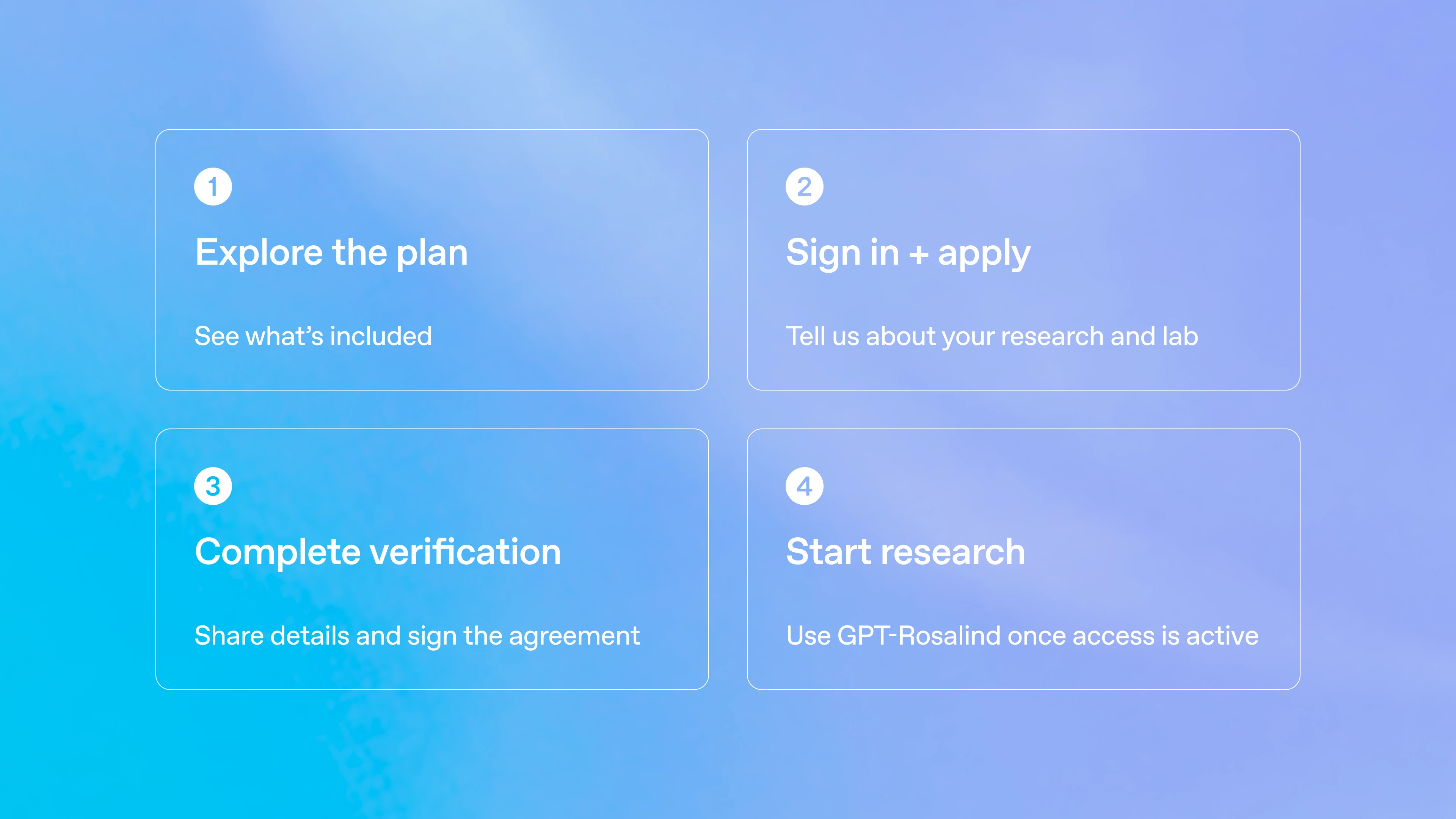
OpenAI introduced the Rosalind Academic Plan, giving eligible academic labs at US universities without an OpenAI Enterprise agreement up to 30 Business Standard seats at no cost for up to 12 months. Access to GPT-Rosalind, OpenAI's specialized life sciences model paired with the Rosalind Workbench for medicinal chemistry, genomics, and wet-lab assistance, is subject to trusted-access approval covering institution legitimacy, PI background, and lab use case, with ongoing monitoring for high-sensitivity work. Research data shared through the plan is not used to train models by default. The post shows GPT-Rosalind supplying candidate comparison matrices for antiviral therapeutic design where the mainline Astra model withholds them. API access is not included.
Why it matters
OpenAI is giving university labs a free, specialized biology AI that can help design drugs and proteins, work the mainline models refuse to touch. Free seats plus trusted access pull top academic groups into OpenAI's stack and shape what the next generation of bio researchers expects from AI tools. For bio-AI startups, the bar just moved: labs will compare your product to something they get for nothing.
Cognition, the startup behind the AI coding agent Devin, is introducing dynamic usage limits that rise automatically for engineers graded 'healthy' or 'satisfactory' on efficiency, measured by estimating the human-hours equivalent of a Devin coding session divided by session cost. It is also launching Devin Coach, an AI that coaches engineers to use AI more efficiently, spotting ambiguous requests, overuse of expensive models, and tasks that should run in parallel, while flagging personal use like vacation planning. VP of customer engineering Calvin Giroud said static caps should give way to limits that adapt to demonstrated efficiency, likening it to credit-card limits. The newsletter's deals section also noted Modal's $750 million Series D at $15.75 billion led by Accel, Salience Labs' $125 million Series B, Labelbox's $100 million-plus Series E, Bending Spoons' $330 million private placement from Berkshire Hathaway, and Nvidia's five-year $250 million UK compute commitment.
Why it matters
Instead of one usage cap for everyone, Cognition will raise limits automatically for engineers who use its coding agent efficiently and coach the wasteful ones. It is credit-card logic applied to AI tokens: prove you spend well, get a bigger line. If it works, every AI coding tool will copy it, and 'tokens per shipped feature' becomes the metric engineering leaders track.