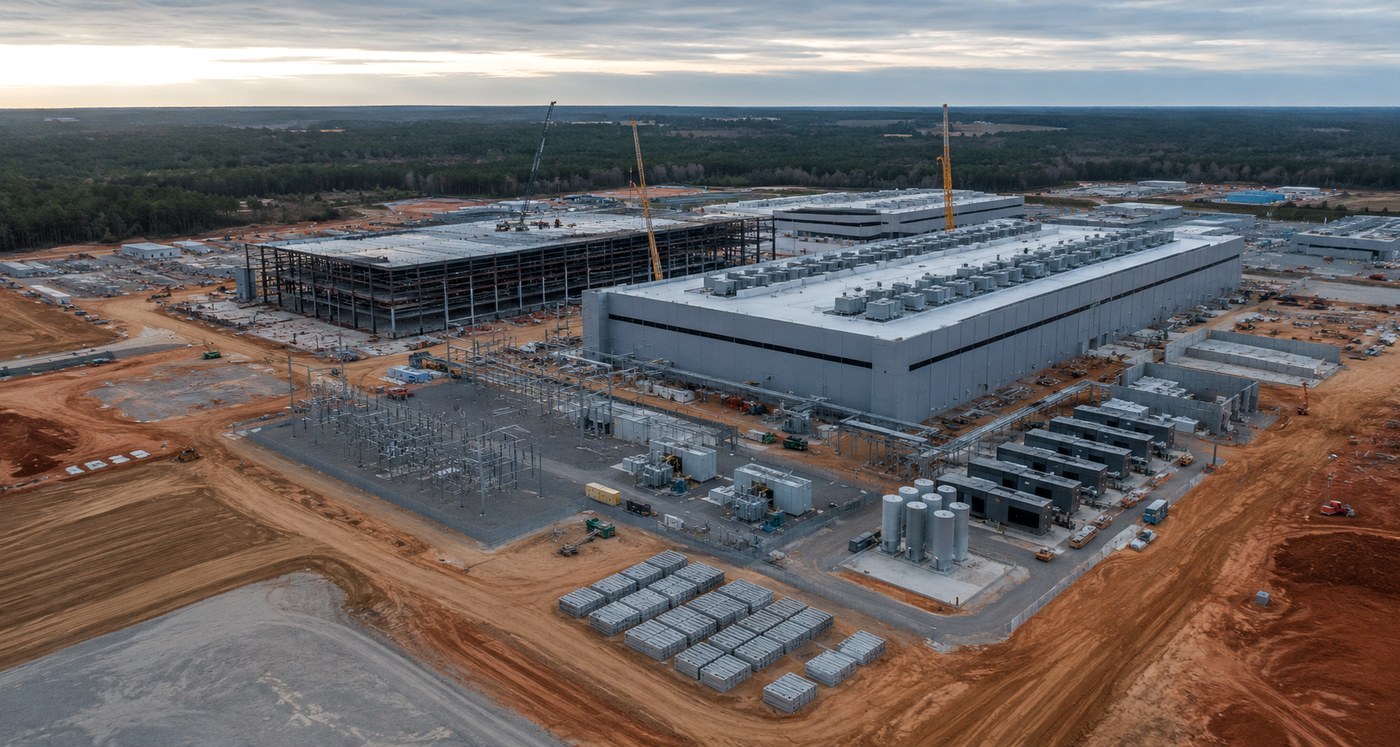
The Information reports Anthropic has signed about $530 billion in data center leasing deals and is pushing partners to build faster ahead of an IPO expected next month. Capacity would grow from 1.4 GW last year to 5 GW this year, 9.5 GW in 2027, and 15-plus GW in 2028 - more than triple Microsoft's entire Azure footprint at the end of 2023. At a 330-MW site in St. Francisville, Louisiana run by Hut 8 with Google AI chips supplied by Anthropic, one month of early capacity could mean $1.3B-plus in extra revenue, and analysis suggests the site could earn about 85% gross margin on inference. Anthropic has flipped from spending $2.30 for every $1 of revenue in spring 2025 to a slight profit in the June 2026 quarter, and it increasingly rents power rights from former bitcoin miners (Hut 8, TeraWulf, IREN, Nscale).
Why it matters
Training used to be the money furnace; now inference at scale is the profit engine, with gross margins that look like software. Whoever locks up grid-connected power first wins, and Anthropic is buying it from bitcoin miners because they hold the interconnection rights. For founders, this reprices everything downstream: compute costs keep falling, but access to capacity at the right moment becomes the real moat.
Charles Lamanna, 38, Microsoft's new EVP overseeing Office and Copilot engineering, won over Satya Nadella last summer by proposing Microsoft pay for Anthropic's models to fix Copilot's buggy Excel and PowerPoint automation. Corporate Copilot users have more than doubled this year to over 30 million, with customers like AT&T (about 18,000 seats) noting the improvement, and Microsoft is now on track to pay Anthropic more than $2B a year. Lamanna calls Microsoft "the Costco of AI," is pushing agent mode as the default and a homegrown model router that picks the cheapest model per task, and now runs an organization of roughly 25,000 people with a seat at quarterly board meetings, making him a potential Nadella successor.
Why it matters
The biggest enterprise AI vendor just declared that models are interchangeable commodities and routing is the product. When Microsoft shops models like bulk goods, every lab's pricing power shrinks and the winners are whoever can be cheapest per task without breaking quality. Founders building on a single model should copy the router, not the loyalty.
Microsoft announced Maia 300, its latest homegrown AI chip, with multi-gigawatt deployments planned starting next year to cut Nvidia dependence and lower Copilot's operating costs. Nadella said the chip is 40% more efficient than leading GPU-based systems and that Microsoft will rely on it primarily for its own AI applications. Scaling is the hard part: The Information reported in August that Microsoft was in talks with TSMC for capacity to build over 300,000 chips, and multi-gigawatt deployment would require millions; Microsoft has also tried to recruit Anthropic as a customer with no large wins yet.
Why it matters
The hyperscalers are done being tenants of Nvidia's pricing power and are becoming chipmakers themselves. If Maia works at multi-gigawatt scale, Copilot's cost floor drops while rivals still rent GPUs at list price. Watch the TSMC order and whether any outside customer signs: adoption is the only proof that matters.
A stealth AI video startup co-founded by Jeffrey Katzenberg, former Sora research lead Bill Peebles, and ex-Dropbox CFO Sujay Jaswa is in talks to license and customize Sora (possibly including model weights), with OpenAI taking equity - after OpenAI killed Sora and its TikTok-like app earlier this year to focus on ChatGPT. The same newsletter reports OpenAI told investors its annualized revenue was approaching $50B at the end of September (about $20B less than other recent reports), confirms TypeSafe AI raised $870M at $7.5B led by a16z, says Nvidia-backed Firmus withdrew its $30B-plus IPO in favor of a $2-3B private round, and says Amazon is in talks to acquire Israeli AI chip startup Decart for about $7B.
Why it matters
OpenAI is renting out the projects it culled, a sign that focus has a price and video generation is now someone else's business to build. The TypeSafe number confirms what was rumor last week: decision models are a $7.5B category. And the Firmus retreat plus Amazon's chip shopping show the buildout's financing is shifting from public markets to private rounds and vertical buys.
SpaceX announced a deal to acquire a nationwide low-band spectrum portfolio of up to 14 MHz of paired spectrum in the 800 MHz band, which it says closes the last technical gap to making Starlink Mobile "a major mobile carrier in the US." The same week, the FCC approved the Starlink Mobile Gen2 constellation: 15,000 satellites optimized for 2 GHz globally, with V2 satellites delivering more than 100x the bandwidth of the current generation for high-speed service directly to unmodified phones. The FCC also authorized the full Ka/V/E/W backhaul bands used by V3 broadband satellites to work with the existing Starlink gateway network.
Why it matters
SpaceX is no longer selling satellite internet as a rural add-on; it is assembling a full mobile carrier from orbit plus terrestrial spectrum. If direct-to-phone bandwidth jumps 100x, carriers go from partners to competitors and every dead-zone map becomes a coverage map. Watch what the incumbents pay to keep their spectrum relevant.
Meta has banned advertisements from ByteDance on its platforms in the US, Canada, Egypt, Indonesia, Japan, Thailand, and Vietnam, and the ban also covers third-party ad campaigns that link to TikTok and other ByteDance apps. The move follows TikTok's deal late last year to sell most of its US data-security subsidiary to US-led investors, which let it avoid a US ban. (Reported via Bloomberg and other media, per the briefing.)
Why it matters
The platform war moved from app stores to ad budgets. Cutting off ByteDance's ability to buy growth on Instagram and Facebook is a direct tax on TikTok's user acquisition, and it tells every advertiser that the two ecosystems are now closed to each other. Founders dependent on paid social should treat cross-platform diversification as urgent, not optional.
Bain Capital-owned Bridge Data Centres is in talks with banks to grow the loan for its Malaysia operations from $2.8B to about $6.6B, which would rank among Asia's largest data center debt financings, with the expanded deal possibly launching by November. The Singapore-headquartered company is a unit of Wintrix (formerly Chindata), which Bain took private in 2023 for $3.16B.
Why it matters
The AI buildout is being financed as infrastructure debt, not venture equity, and Asia is now writing the biggest checks. When data centers borrow like utilities, the winners are whoever can sign long-dated tenant contracts to back the loans. It is another data point that the binding constraint is bankable demand, not technology.
On a panel this week, Cloverleaf Infrastructure co-founder Brian Janous argued AI data center developers should treat projects like oilfields and share expected profits with host communities, citing Alaska (about $31B paid to residents since the 1970s) and Kazakhstan/Azerbaijan (roughly 80% of oil profits to host countries). Opposition is now a top issue ahead of the Nov. 3 midterms: a September NYT poll found 61% of likely voters oppose data center construction, and The Information has tracked at least 550 states and localities with active moratoriums. McKinsey estimates developers will spend almost $3T on US AI data center buildout by 2030; Amazon's $1B community pledge and a $10,000-per-resident offer in Hazle Township, Pennsylvania were judged insufficient.
Why it matters
The buildout's bottleneck is no longer chips or money, it is permission. A 61% opposition rate plus 550 moratoriums means timelines now depend on local politics, not supply chains. The developers who learn to pay communities like oil companies will build; the ones who fight them will wait in the queue.
At a Biohub reception this week, Mark Zuckerberg said the Chan Zuckerberg Initiative's goal of curing all disease by century's end no longer seems crazy thanks to AI advances. CZI announced a $1.8B partnership between Biohub, the NIH, and the Department of Energy to build infrastructure for "AI-powered biology," plus $300M in commitments from Meta, Google DeepMind, and Isomorphic Labs, on top of Biohub's $500M Virtual Biology Initiative launched in April. The piece frames big tech as taking over the scientific leadership role once held by universities: Zuckerberg sits on Trump's science advisory council alongside Sergey Brin, Larry Ellison, and Jensen Huang, and Brin and Huang received National Medals of Science on Oct. 8.
Why it matters
The frontier labs are colonizing basic science, and the government is paying them to do it. When $1.8B of federal biology infrastructure runs on industry AI, the next generation of scientific tools gets designed inside tech companies first. For investors, biotech AI just got a state-backed distribution channel.