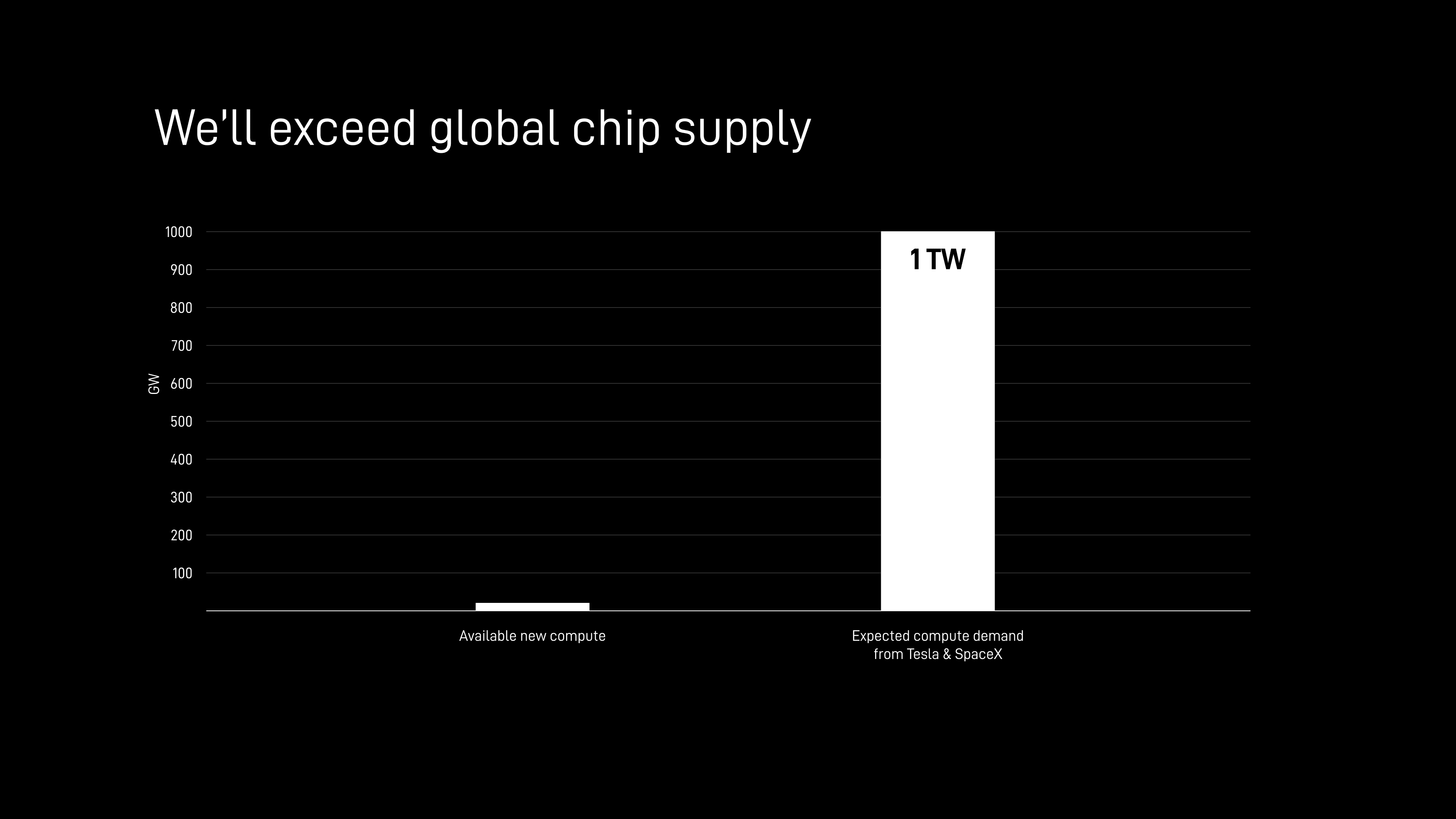
SpaceX announced on its updates page that Terafab will be built in Grimes County, Texas: a vertically integrated fab with more than 100 million square feet of manufacturing space, covering advanced logic and memory manufacturing, packaging, and testing under one roof. The initial phase needs about $16.8B in capital from SpaceX and Tesla and will employ at least 3,000 people. The chips target edge compute and inference for Tesla's Optimus robots and Cybercabs, plus high-power chips for SpaceX's space-based data centers; SpaceX says combined chip demand will exceed 1 terawatt of compute, larger than current global supply.
Why it matters
What it means: two private companies are building their own chip supply because the AI compute race is no longer about buying more GPUs, it is about owning the factories and the power behind them. If the bet is right, the next winners are not chip buyers but whoever controls manufacturing capacity; watch whether other hyperscalers follow by building their own fabs, which would reshape demand for Nvidia, TSMC, and the whole supply chain.
a16z announced it is leading the Series A for TypeSafe, whose model Jev returns typed decisions (Choice, Score, Boolean) with probabilities instead of generated text. a16z says Jev runs at 1/100 to 1/500 the cost of frontier models and is about 100x faster for classification tasks at comparable accuracy; Jev generated 1 trillion tokens in its first 3 days after launch. Sequoia announced it is partnering in the same round, behind a16z, noting Jev became the fastest-adopted model in Vercel's AI Gateway history within 24 hours of its September 15 launch, and that a quarter of the Fortune 500 have integrated it. Co-founder Diogo Almeida co-invented InstructGPT/RLHF at OpenAI.
Why it matters
What it means: two top-tier firms are validating a new category in the same week: small, cheap 'System One' models built for software to call thousands of times a second, not for people to chat with. If this becomes the next platform layer, value shifts from whoever has the smartest model to whoever owns the decision primitive every app calls; labs selling expensive tokens for routine classification just got a pricing anchor far below them.
On this week's 20VC episode (Oct 8), a roundtable with MongoDB CEO Dev Ittycheria, Jason Lemkin, and Rory O'Driscoll worked through the week's market signals: ElevenLabs doubling its valuation to $22B; Salesforce acquiring Listen Labs for $2B; Vercel reaching $600M in ARR with AI agents driving half of new business; former Groq engineers suing over Nvidia's $17B acquisition; and Oura pulling its IPO despite 74% growth. The trio also debated the 'Cognition vs Factory' talent war and whether OpenAI's momentum has shifted the balance with Anthropic.
Why it matters
What it means: one episode captures how top SaaS investors read the market right now: revenue credibility is back in style (Vercel's agent-driven ARR), acquirers still pay up for AI teams and products (Salesforce at $2B, ElevenLabs at $22B), and the IPO window looks fragile again (Oura pulling despite strong growth). For founders weighing a raise versus a sale, buyers are active while public-market exits stay shaky.
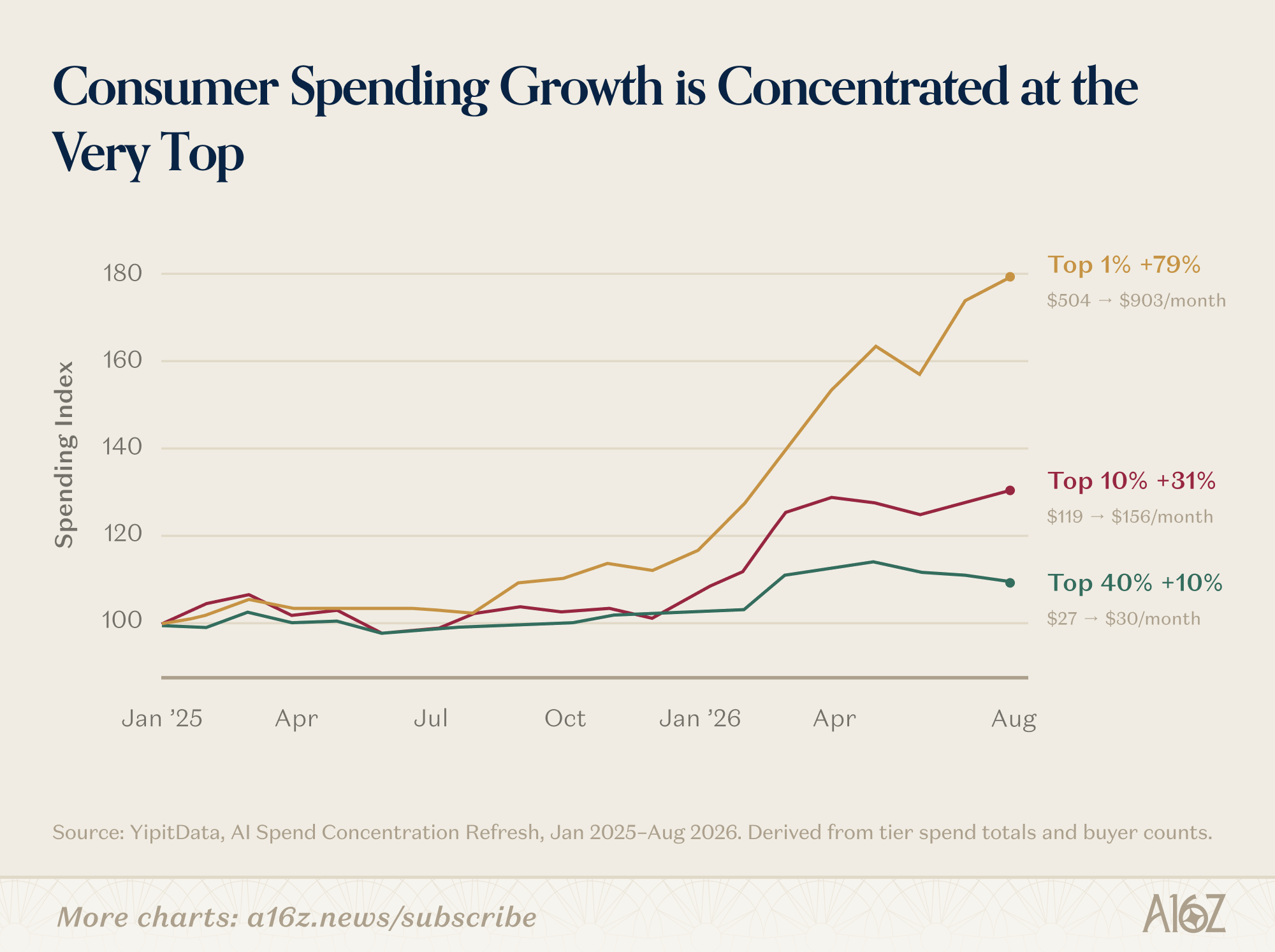
The 7th edition of a16z's Top 100 Gen AI Consumer Apps adds US consumer card-spending data (YipitData) to traffic rankings for the first time. As of August, just 4.5% of US consumers held an active paid subscription to ChatGPT, Gemini, or Claude, up from 2.1% a year ago. Spending follows a sharp power law: the top 1% of payers account for 19.5% of all observed consumer AI spend (more than the bottom 50% combined), averaging $903/month versus a $25 median. Claude has passed Gemini on US paid subscribers; Meta's Muse crossed 5M downloads in under a month; agent startup Instinct reportedly passed $1B in annualized transaction volume.
Why it matters
What it means: consumer AI is not a mass subscription market yet, it is a prosumer power market where a tiny slice of heavy users buys tools to build and create. That is why a16z argues the next wave needs a different business model: agents monetized on the transactions they complete, not seats they occupy. Connecting thread with the TypeSafe item: as per-decision intelligence gets near-free, charging per seat tops out; the money moves to whoever takes a cut of the transaction the agent completes.
SpaceX said Starship is moving into orbital flight starting with Flight 14: missions will deliver Starlink V3 satellites and attempt the first orbital propellant transfer, using a passively safe suborbital profile with a circularization burn once the vehicle checks out healthy. Chun Wang, commander of the Fram2 polar mission, announced he will fly aboard Starship's first interplanetary human spaceflight: a two-year mission that leaves the Earth-Moon system, flies by Mars, and returns. Before that, Wang will join Dennis and Akiko Tito on the first commercial circumlunar Starship flight, a week-long trip passing within 200 km of the Moon's surface.
Why it matters
What it means: Starship is shifting from test campaign to revenue flights, and the first commercial deep-space customers are now real: a Mars flyby and a lunar loop are sold, not speculative. For investors, this sets the cadence for Moon and Mars launch demand years ahead of government timelines; for everyone else, it is a reminder that the orbital economy is about to have its first paying tourist-grade deep-space market.
a16z announced an investment in Preference Model, which builds reinforcement-learning environments for AI labs focused on ML-engineering tasks: writing kernels, debugging training runs, curating data, designing experiments. Founders Jennifer Zhou (early Anthropic, built pretraining data infra) and Ning Cao (ex-DatologyAI) are open-sourcing Karotte, their RL-environment framework, hardened through more than a million evaluation runs plus red-teaming, with defenses against reward hacking (killing stray processes before grading, rejecting grader-crashing files).
Why it matters
What it means: the binding constraint on self-improving AI engineers is no longer raw model smarts but the quality of the training environments, and specifically environments models cannot cheat. As labs push agents to write their own kernels and run their own experiments, whoever supplies the trusted proving ground sells picks and shovels to every lab at once.
The White House suspended a visa program for Microsoft and other tech firms, per The Information's homepage. Microsoft said in a statement it pays H-1B employees the same as other employees and primarily sponsors visas for immigrants already working in the US.
Why it matters
What it means: immigration enforcement is now aimed directly at Big Tech talent pipelines, not just at the border. Founders planning hiring over the next year should price in slower, costlier foreign hiring and a hotter market for domestic engineers; it is another push toward agents and automation doing work that is hard to staff.