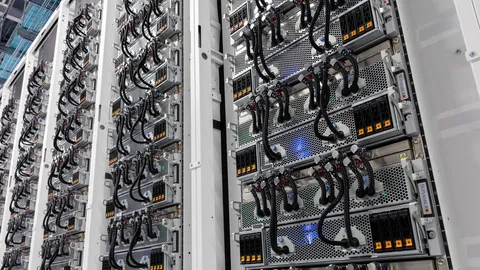
AI cloud company Lambda secured its first delayed-draw term loan of more than $1 billion to buy 30,000+ Nvidia GPUs, split between GB300 and VR200 chips at data centers in Seattle, Kansas City, and Dallas. The fixed-rate facility carries 6.78% interest and received investment-grade ratings from Morningstar DBRS and Moody's; proceeds fund three confirmed projects with two investment-grade customers. It is Lambda's second institutional credit facility, following a $926 million term loan closed in late August.
Why it matters
The AI buildout has become a financing race, and the winner is whoever borrows cheapest. An investment-grade rating lets Lambda pay 6.78% while riskier rivals pay 9-10%, and that gap compounds across billions in GPU purchases. Expect compute capacity to concentrate in a few big renters rather than fragment; if you buy cloud GPUs, watch the borrower's credit rating, not just their price list.
OpenAI fired three safety employees - an AI safety researcher, an alignment researcher, and an alignment research program manager - for mishandling corporate information, including sharing sensitive material with an outside organization that evaluates AI models. An OpenAI spokesperson said the investigation found "a pattern of misconduct, including mishandling research information in violation of company policies."
Why it matters
The same month OpenAI is auditioning to look like the responsible lab, it fired its own safety staff for talking to an external evaluator. The real fight is over who gets to look inside the models and publish what they find. Expect labs to keep audits on their own terms and tighten access; outside safety groups will keep pushing for the right to verify, not just trust.
Data-center infrastructure provider Accelevation raised $540 million selling 30 million shares at $18 each - below the marketed $20-24 range - and traded down roughly 5% on its first Thursday morning. The private-equity-backed company (Olympus Partners acquired it last January) sells power and infrastructure products to data centers.
Why it matters
Public markets are done paying up for AI infrastructure stories without proof. A below-range pricing plus a first-day slide is a verdict: the IPO window now rewards cash flow, not capex plans. If you run a private AI-infra startup, this is the comp your banker will quote the next time you talk about going public.
Backed by a $100 million commitment, Anthropic launched the Claude Frontier Academy to train 10,000 Frontier Deployed Engineers by the end of 2027. The FDE Residency follows a medical-training model: a multi-day in-person program with a simulated enterprise deployment plus a graded practical, then a 12-week residency leading a real Claude project at their own organization. First cohorts draw from the Claude Partner Network - Accenture, Bain, Capgemini, Commonwealth Bank of Australia, Deloitte, McKinsey, Morgan Stanley, Novo Nordisk - and are running now in San Francisco, New York, and London.
Why it matters
Anthropic just said out loud that the scarce thing in enterprise AI is no longer the model; it is the people who can deploy it. By minting 10,000 certified engineers inside consultancies and banks, Anthropic is buying the deployment workforce behind its own distribution channel. The lab that owns the talent pipeline wins the enterprise contracts, not just the benchmarks.
U.S. authorities arrested Greg Lui, owner of Earthmade Computer Inc in the San Gabriel Valley, for allegedly moving more than $300 million of servers containing restricted Nvidia chips to China via Malaysia and Singapore from 2023-24. Separately, Semi-Tech Leasing Group, a financing company owned by several local Chinese government entities, disclosed it funded Glory View Technology's purchase of more than 700 servers, at least 32 equipped with B300 chips whose sales to China are prohibited.
Why it matters
The chip war has two faces on the same day: Washington arresting a middleman, and Chinese government funds quietly buying the very chips the bans target. Export controls create a gray market, and the gray market scales with demand. The practical effect is a tax and a delay on Chinese compute, not a cutoff; plan around persistent leaky supply, not a clean decoupling.
Tokenless (S26) launched EnvCheck, an agent harness that audits RL environments and evals for reward hacks before training, and reported 110 flaws across three major benchmarks: 70 in DeepSWE, 24 in Terminal-Bench, and 16 in BFCL - including a bug that makes a task easier for the agent to solve than intended.
Why it matters
The yardsticks everyone uses to measure agents are cracked. If a benchmark can be gamed by accident, a high score may mean the agent found the shortcut, not that it did the work. Anyone training agents should audit their evals before trusting them; the winning teams will be the ones whose tests actually punish cheating.
AWS pledged to spend $1 billion over five years upgrading heat and water systems in schools, homes, and municipal buildings to win over communities fearful of data centers, and promised to stop requiring local governments to sign nondisclosure agreements over its data-center deals. CEO Matt Garman defended the expansion as "a race our nation can't afford to lose."
Why it matters
Amazon is paying a community tax to keep building. The fight over data centers has moved from tech Twitter to town halls, and the biggest builder is spending $1 billion to buy local goodwill. Smaller builders cannot match that check; watch for community consent to become a moat only the hyperscalers can afford.
A federal judge in the District of Columbia dismissed antitrust lawsuits from Chegg and Penske Media (owner of Rolling Stone and Variety), rejecting the claim that Google trades search traffic for content. Meanwhile, Google now pays roughly 100 digital publishers based on how much their content contributes to AI-powered answers.
Why it matters
Courts will not force Google to share search traffic; the only path left for publishers is a licensing check. Google paying ~100 publishers is the template: if your content trains or feeds AI answers, you negotiate a deal, not a lawsuit. Content businesses should price their archives for AI licensing now, because the courtroom door just closed.
Rachel Hu of Energent AI (S23) ran 12 models from Anthropic, OpenAI, and Google DeepMind through the same harness and showed that sorting by different metrics picks different winners: GPT-6 Astra is the most accurate (73.3%), Sonnet 5.5 uses the fewest tokens per question and is cheapest per finished question at $0.25 (2.6x fewer tokens than the field), and GPT-5.6 Terra has the cheapest token price at $0.43 per million.
Why it matters
Stop buying models by sticker price. A cheap token that wastes calls costs more than an expensive token that finishes the job in one shot. The real unit to negotiate on is cost per finished answer, and the vendor that wins your workload is whoever wastes the fewest steps, not whoever advertises the lowest price.
Harry Stebbings interviewed Chase Lochmiller, co-founder and CEO of Crusoe, which has raised roughly $6.4 billion including a $3.9 billion Series F at a $30.9 billion valuation. The Oct 3 episode covers what blocks new AI data centers, whether half of planned data centers never get built, how quickly a GPU pays for itself, whether GPUs go obsolete before payback, and why most moats do not exist.
Why it matters
The most important question in AI infrastructure is not how many GPUs you can buy but whether they pay for themselves before they become obsolete. Crusoe's CEO is saying the industry's core anxiety out loud. Anyone signing long-term compute contracts should run the same math: at what utilization do these numbers break?